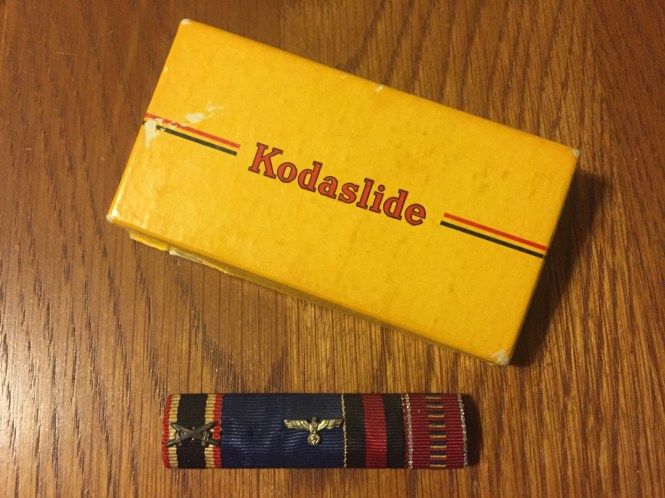
It came in a Kodaslide box, mailed to C. B. Eason of Fort Worth, Texas with a postage stamp dated March 26, 1946. Carefully wrapped in yellowed wax paper, it tells of the intertwined lives of two soldiers.
Columbus B. Eason was born on January 14, 1926 to William Eason, a farmer, and his wife Alice. [1] At the age of 18, he enlisted in the U.S. Army at Fort Sill, Oklahoma on April 10, 1944. [2] After he passed on September 5, 1991, he was buried in the Garden Valley Cemetery in Smith County, Texas. His tombstone is a simple Veteran’s Affairs marker, noting his service as a Private in World War II. [3]
The artifact inside the Kodaslide box belonged to another soldier though. It is a German ribbon bar of World War II vintage. The ribbon bar denotes the recipient earned at least five awards during his service in the German Wehrmacht (Army). Ask any Soldier, Sailor, Airman or Marine and they will tell you that a ribbon bar tells a history of the service member wearing it. This is the story told by this German ribbon bar.
The soldier who owned this was not a junior Private with only a couple years of service like Private Columbus Eason. Two corn flower blue ribbons of the Military Service Honor Award are side by side near the center of the ribbon bar. The lower precedence ribbon has a silver device on it, denoting 4 years of service in the Wehrmacht. According to Medals & Decorations of the Third Reich: Orders, Decorations, Badges, the higher precedence ribbon (which is missing its device) would have indicated 12 or 18 years of service in the Wehrmacht. [4]
The earliest award on the ribbon bar is the October 1, 1938 Commemorative Medal (Die Medaille zur Erinnerung an den 1 Oktober 1938.) It was authorized by Adolph Hitler “on October 18, 1938 for meritorious service in the reuniting of the Sudetenland German area with the Greater Germany.” The Anschluss of Austria into the “Greater Germany” in March 1938 saw Adolph Hitler authorize the March 13, 1938 Commemorative Medal (Die Medaille zur Erinnerung an den 13 Marz 1938) on May 1, 1938. The medal was awarded to persons in Austria who were instrumental in the unification or to members of the armed forces, police, Schutzstaffel (SS) and NSKK who took part in the unification. [5]
The other service award on the ribbon bar is not German, but Romanian. The Commemorative Medal for the Crusade Against Communism was awarded to Romanian and Axis soldiers between the start of Operation BARBAROSA in 1941 until 1944.
The final award on the ribbon bar, and the highest in precedence, is the War Merit Cross 2nd Class with Swords. Adolph Hitler established the War Merit Cross on October 18, 1939 to commemorate the victory at the Battle of Leipzig. The award was created to recognize wartime meritorious service and was patterned after the Iron Cross. The red, white and black ribbon was a mirror image of the 1939 version of the Iron Cross. When awarded with Swords, it denotes “meritorious action under enemy fire or combat activities.” Symbolic of its connection to the older, more prestigious Iron Cross, recipients of the Iron Cross would typically present the War Merit Cross to soldiers. [6]
To the victors go the spoils, and the young American soldier far from home took possession of the awards of the veteran German soldier. Two lives intertwined by one artifact, telling the story of a farm-boy from Texas traveling to Germany at the end of a war.
Sources:
- United States of America, Bureau of the Census. Fifteenth Census of the United States, 1930. Provo, UT, USA: Ancestry.com Operations Inc, 2002.
- National Archives and Records Administration. U.S. World War II Army Enlistment Records, 1938-1946 [database on-line]. Provo, UT, USA: Ancestry.com Operations Inc, 2005.
- Find-a-Grave Website. Memorial #20841509.
- Doehle, Heinrich. Medals & Decorations of the Third Reich: Orders, Decorations, Badges. Trans. William E. Hamelman. Denison: Reddick Enterprises, 1995. Print. Pg. 46 – 48.
- Ibid. Pg. 61 – 62.
- Ibid. Pg. 25 – 29.
 The Things We Leave Behind