The Good Conduct Medal was named to Robert E. Barnhart and dated 1942, and came on a mounted medal bar. The regulations and history of the medals themselves tell both the story of the medals and when and how the recipient earned the medal. But, who was Robert Barnhart? And if the medals and ribbons a service member receives tells the story of their service, what story does this medal bar tell? The story that follows takes us to the early days of World War II in the Pacific, and a man whose life these events swirled around.
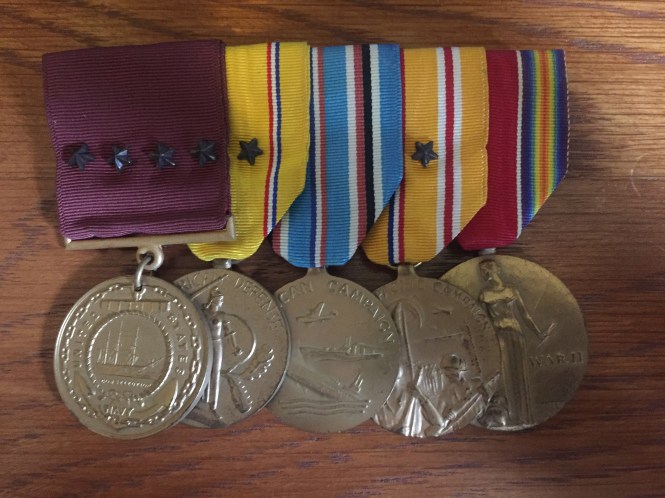
The Navy Good Conduct Medal occupies the position of the highest award earned by Robert Barnhart. Established in April 26, 1869 by Secretary of the Navy A. E. Borie, [1] the Navy Good Conduct Medal was awarded to sailors initially on completion of an enlistment with “a clear record.” In 1880, the modern design of the medal, with a depiction of the USS Constitution on the obverse and “Fidelity – Zeal – Obedience” on the reverse. The name of the sailor and the year the enlistment ended were typically engraved or stamped on the medal. The Navy History & Heritage Command website notes the Navy Good Conduct Medal is the third-oldest continuously presented award after the Navy Medal of Honor and the Army Medal of Honor. [2]
Robert Barnhart would have to have enlisted in 1938 according to the stamped inscription “Robert E. Barnhart 1942” on the reverse of his Navy Good Conduct Medal. Depending on supplies at the time, he may have waited until after the war to be presented with his medal. In 1942, the Bureau of Personnel suspended award of the Good Conduct Medal due to wartime shortages in medal. [3] The four Bronze Service Stars on the suspense of the medal indicates Robert Barnhart continued his Naval Service after the war in either the Regular Navy or Naval Reserve, earning subsequent awards of the Navy Good Conduct Medal in 1946, 1949, 1952, and 1955. [4]

The American Defense Service Medal is the second highest award on the medal bar, and was “awarded to all persons in the naval service who served on active duty at any time between 8 September 1939 and 7 December 1941.” The Bronze Service Star on the ribbon is worn in lieu of a bronze service clasp denoting Robert Barnhart earned either the “FLEET” or “BASE” bar.
On November 6, 1942, President Franklin D. Roosevelt established the American, European-African-Middle Eastern and Asiatic-Pacific campaign medals. This ribbon bar has the American Campaign Medal and the Asiatic-Pacific Campaign Medal with one Bronze Service Star. This denotes Robert Barnhart participated in one of the 48 official Navy and Marine Corps campaigns of World War II in the Pacific theater. The final medal is the World War II Victory Medal. [5]
A search for records on Robert E. Barnhart finds him on the passenger list for the USS Kanawha on December 26, 1940 enroute from San Diego, California to Pearl Harbor, Hawaii. He was listed as an Aviation Ordnanceman Third Class. On January 5, 1941, he was transferred to Patrol Squadron 11 (VP-11) assigned to Naval Air Station Pearl Harbor. VP-11 was redesignated Patrol Squadron 21 (VP-21) on February 1. July unit rosters indicate he was sent to Bombsight School. He embarked on the USS William Ward Burrows on November 28, bound for Wake Island with VP-21. He had been promoted to Aviation Ordnanceman Second Class by this time. [6] VP-21 was ostensibly going to Wake Island to participate in “fleet exercises” with the aircraft of the Squadron arriving at Midway Island on December 1. [7]
The USS William Ward Burrows was ordered to return to Pearl Harbor on December 8, to offload her passengers and cargo at Johnston Atoll. In addition to the attack on Pearl Harbor, the VP-21 aircraft at Midway had been shelled by the Japanese destroyers Ushio and Akebono. On December 13, AOM2 Robert Barnhart returned to Johnston Island Air Field. Two days later a Japanese submarine shelled the island. It is unsure whether AOM2 Barnhart weathered the battle at the Air Field or onboard the USS William Ward Burrows. [8]
AOM2 Barnhart was likely involved in the generation of sorties for VP-21 in the months that followed though. On January 6, VP-21 reported a patrol sank an enemy submarine in the waters off Hawaii, but post-war records show no Japanese submarine losses during that period. [9] He transferred to VP-101 on April 18, 1942. [10]
Sources:
- Navy and Marine Corps Awards Manual. NavPers 15,790. 1953.
- http://www.history.navy.mil/browse-by-topic/heritage/awards/service-campaign/navy-good-conduct-medal.html
- Ibid.
- Navy and Marine Corps Awards Manual. NavPers 15,790. 1953.
- Ibid.
- Ancestry.com. U.S. World War II Navy Muster Rolls, 1938-1949 [database on-line]. Provo, UT, USA: Ancestry.com Operations Inc, 2011.
Original data: Muster Rolls of U.S. Navy Ships, Stations, and Other Naval Activities, 01/01/1939-01/01/1949; A-1 Entry 135, 10230 rolls, ARC ID: 594996. Records of the Bureau of Naval Personnel, Record Group Number 24. National Archives at College Park, College Park, MD.
- Dictionary of American Naval Aviation Squadrons. Vol. 2 Pg. 120.
- Dictionary of American Fighting Ships Online. http://www.history.navy.mil/research/histories/ship-histories/danfs/w/william-ward-burrows.html
- Dictionary of American Naval Aviation Squadrons. Vol. 2 Pg. 121.
- Ancestry.com. U.S. World War II Navy Muster Rolls, 1938-1949 [database on-line]. Provo, UT, USA: Ancestry.com Operations Inc, 2011.
Original data: Muster Rolls of U.S. Navy Ships, Stations, and Other Naval Activities, 01/01/1939-01/01/1949; A-1 Entry 135, 10230 rolls, ARC ID: 594996. Records of the Bureau of Naval Personnel, Record Group Number 24. National Archives at College Park, College Park, MD.
 The Things We Leave Behind