It is the kind of horrific weapon only a war can produce. The blade is triangular in shape and extends slightly over 9 inches from the hand guard. It is crafted to pierce clothing and leather with ease, and easily penetrate deeper in the man beneath those clothes with minimal friction on the blade. The guard extends around the wooden grip, with raised triangular knobs to focus the pressure of a punch with bone crushing results while protecting the hand. It is a Model 1917 Trench Knife. And despite its horrific capabilities, the men of the American Expeditionary Force (AEF) found it lacking in combat efficiency.
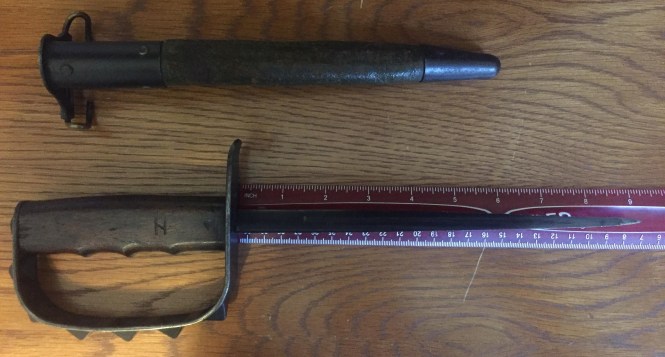
The Model 1917 Trench Knife was designed by Henry Disston & Sons of Philadelphia, PA based off a French commercially designed knife sold to the Poilu (see footnote A for an explanation of the term.) Landers, Frary & Clark (LF&C) produced 113,000 of these knives for the AEF. [1] But, the soldiers of the AEF learned the same lessons which drove German soldiers to make trench knives from shortened bayonets and Poilus to make them out of nails. The reality of the trenches disproves the theories of the designers at times.
In June 1918, the Army Schools of the AEF began a series of tests utilizing the expertise developed by the young infantry officers who had been bloodied in the trenches in the past months. Fredrick P. Todd in “The Knife and Club in Trench Warfare, 1914 – 1918” describes the tests, “Beside our own Model 1917 there was tested a French commercial pattern, an English “knuckle duster,” and an experimental affair called the Hughes knife…. the Hughes invention proved of no value.” (2) The Model 1917 had proved too cumbersome with its long blade; a lesson the Germans had learned early in the conflict with using Mauser bayonets in the hand to hand fighting. Todd also notes in regards to the Model 1917, “the lack of a cutting edge was a serious deficiency.” (3) According to Benedict Crowell, the merits of the different knives were tested with the following questions in mind:
Serviceability, is the knife able to be carried in one hand and operate other weapons simultaneously?
Is the knife quick in action?
If the soldier were knocked unconscious, would the knife drop from his hand?
What is the probability of being knocked out of hand when fighting?
What is the knife’s suitability to carry while crawling? [4]
None of the knives tested were acceptable to the officers at the Army Schools of the AEF. Instead, a new design was created. While the weight, length, and shape of the blade was taken into account, special attention was paid to the shape of the handle which gave the new knife its most distinctive feature. While commonly known as the Model 1918 because of the “1918” stamped into its bronze handle, its official designation was the Mark 1 Trench Knife.
The War Department contracted with A.A. Simmons & Son (Dayton, OH), Henry Disston & Sons, Landers, Frary & Clark, and the Oneida Community Ltd. to produce over 1.2 million of the Mark 1 trench knives with delivery to begin in December 1918. All contracts except LF&C were cancelled when the war ended on November 11, 1918. [5]
Realizing the American companies would need to retool, and would not be capable of putting significant quantities of the knives in the trenches by year’s end, the AEF contracted with the Au Lion company in France to expedite production of the new trench knives. Which leads us to our second artifact.
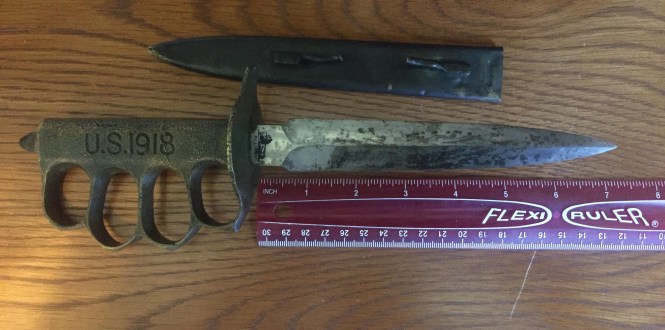
The Au Lion Mark 1 Trench Knives are shorter than their Model 1917 predecessors. The double edged, stiletto blade measures 6 1/2 inches in length with the reclining lion trademark on the ricasso. The nut on the pommel doubles as a “skull crusher.” Originally, the blades were highly polished, but evidence of doughboys blackening the blades once issued remains. Instead of bronze handles, Au Lion used brass and from a collector’s standpoint the Au Lion blades are typically viewed as lower quality. But, they worked with deadly efficiency and unlike the American Mark 1s, saw combat service.
Footnotes:
A.) Poilu (literally meaning “hairy one”) was a slang term for the French infantrymen of World War I, much like the American “Doughboy” and British “Tommy.” It is a term of endearment, evoking their courage and determination, while referring to their bushy beards or mustaches and their typically rural, agricultural background.
Sources:
- Crowell, Benedict. America’s Munitions 1917 – 1918. Report of Assistant Secretary of War, Director of Munitions. Government Printing Office. Washington, D.C. 1919. Pg. 288.
- Todd, Frederick P. “The Knife and Club in Trench Warfare, 1914 – 1918.” The Journal of American Military Foundation. Vol. 2, No. 3. Autumn 1938. Accessed 09 March 2016. http://www.jstor.org/stable/3038757 Pg. 153.
- Ibid.
- Crowell, Benedict. America’s Munitions 1917 – 1918. Report of Assistant Secretary of War, Director of Munitions. Government Printing Office. Washington, D.C. 1919. Pg. 288-289.
- Ibid.
 The Things We Leave Behind