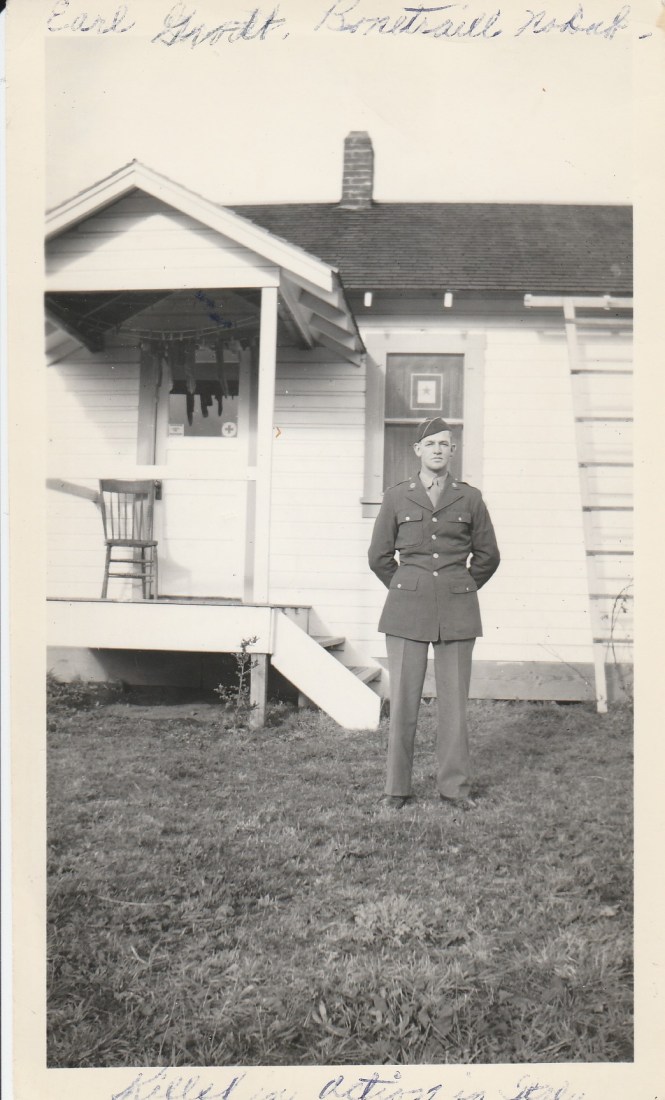
The soldier proudly stands at Parade Rest in his finest dress uniform. A “Son in Service” flag proudly hangs in the window of the house. The words written on the photo though is what drove this research into the life of the man in the photo though.
“Earl Grodt, Bonetraill, No Dak”
“Killed in Action in Italy”
Peter and Kjerste Grodt immigrated to the United States in 1903 from Norway. Their first son was born in 1904 in South Dakota, then they moved to North Dakota before the birth of their daughter, Gida. Their son, Earl was born on February 6, 1916. He would grow up with three older brothers, Gida, and a younger brother in the rural farming communities of Williams County, ND, where the population would not break 20,000 residents during his lifetime. [1] He joined the Army on October 2, 1942 [2] and according to his obituary in The Bismark Tribune was sent overseas in January 1944. [3]
Private First Class (PFC) Earl Grodt was assigned to the 363rd Infantry Regiment, 91st Infantry Division. It is appropriate the farm boy from the frontier of North Dakota was assigned to the “Wild West Division.” The 91st Division was formed at Camp White, Oregon in 1942, PFC Grodt was likely part of the “12,000 recruits, who arrived at Camp White during the months of October and November from all parts of the United States.” [4] Basic training lasted until February 1943, and the remainder of 1943 was focused on building up squad, platoon, company, battalion, and finally regimental tactics. Their capstone was participation in the Oregon Maneuver exercises, which proved the Division was combat ready. On January 20, 1944, the Division received orders to begin movement to the European Theater of Operations.
The 91st Division would travel first to North Africa for further combat training before landing in Naples, Italy on June 15. On July 4, the 363rd Regimental Combat Team, under the command of Colonel W. Fulton Magill, Jr. went into combat near Riparbella, Italy. It is likely over the next nine days, PFC Grodt would see his first combat action. After this action, the 363rd would take part in the fierce mountain fighting through the Arno River campaign to liberate Rome. The 363rd Infantry Regiment would form the “nucleus of Task Force Williamson” playing a leading role in the capture of Leghorn and Pisa in late July. In August, the 363rd Infantry was pulled from the front line to rest, recuperate, and conduct training to prepare for their next campaign. [5]
“The history of the [91st] Division during the month of September 1944 is the story of the breaching of the Gothic Line…. To the combat infantryman the climactic days, 12 – 22 September, were a ‘lifetime of mud, rain, sweat, strain, fear, courage and prayers.” The campaign would consist of three phases: advancing from the Arno River to the Sieve River (4 – 11 September), breaching the Gothic Line (12 – 22 September), and the advance northward from the Santerno River (23 – 30 September.) [6]
During Phase II, the 363rd Infantry’s objective was the key anchor of the Gothic Line in their sector. By September 17, the 363rd was preparing for the final assault on Monticelli, a heavily fortified position on a key mountain. “It was a climactic day for the troops of the 363rd Infantry. The slopes and crest of Monticelli were a blazing inferno of every type of mortar, artillery, and small-arms fire the dogged enemy forces could amass in a final effort to hold this key terrain fetuare and shatter for forward surge of the attackers.” [7] By September 18, Monticelli had been taken by courage and sheer tenacity of the 363rd Infantry, but the 363rd continued the advance towards Casanova, Italy the following day. [8]
It is unsure whether PFC Grodt died of wounds from earlier combat, or the resistance faced on 19 September. But, his body was returned to Bonetraill, ND and buried in the Saint Petri Lutheran Cemetery. His father filled out the Department of Veteran’s Affairs application for his headstone in 1949.
Immigrants, proud of their son’s service to his nation, always remembered.
Sources:
- Ancestry.com. 1920 United States Federal Census [database on-line]. Provo, UT, USA: Ancestry.com Operations, Inc., 2010. Images reproduced by FamilySearch.
Original data: Fourteenth Census of the United States, 1920. (NARA microfilm publication T625, 2076 rolls). Records of the Bureau of the Census, Record Group 29. National Archives, Washington, D.C.
- Ancestry.com. U.S., Headstone Applications for Military Veterans, 1925-1963 [database on-line]. Provo, UT, USA: Ancestry.com Operations, Inc., 2012.
Original data: Applications for Headstones for U.S. Military Veterans, 1925-1941. Microfilm publication M1916, 134 rolls. ARC ID: 596118. Records of the Office of the Quartermaster General, Record Group 92. National Archives at Washington, D.C.
- “Dakotan Killed in Italy.” Bismark Tribune. Oct 13, 1944. Bismark, ND. Pg. 7
- Robbins, Robert A. Major, USA. The 91st Infantry Division in World War II. Infantry Journal Press. Washington, D.C. 1947. Pg. 7
- Ibid. Pp. 8 – 91
- Ibid. Pg. 92
- Ibid. Pg. 106
- Ibid. Pp. 107 – 192.
 The Things We Leave Behind