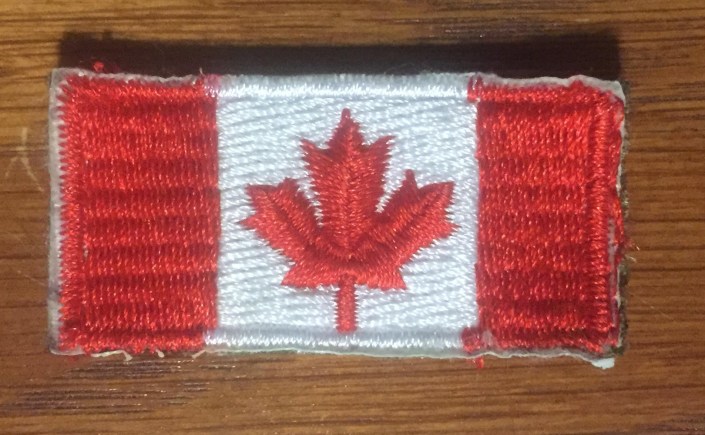
When I was a young, freshly minted Lieutenant, I served alongside Canadian airmen in the 12th Space Warning Squadron at Thule AB, Greenland. I came to have a profound respect for our Northern neighbors. The mentorship of one of their Sergeants contributed greatly to my development as a young officer and my success as a man. I was as proud to wear their Maple Leaf flag on my shoulder as I was my own Stars and Stripes. When I saw two Canadian Decorations in an antique shop in Florida, I wanted to ensure they were given a respectful home.
The Canadian Forces Decoration is one of the two oldest continuously awarded honors in the Canadian Honors System, and recipients of the Canadian Forces Decoration are entitled to the postnomials “CD.”
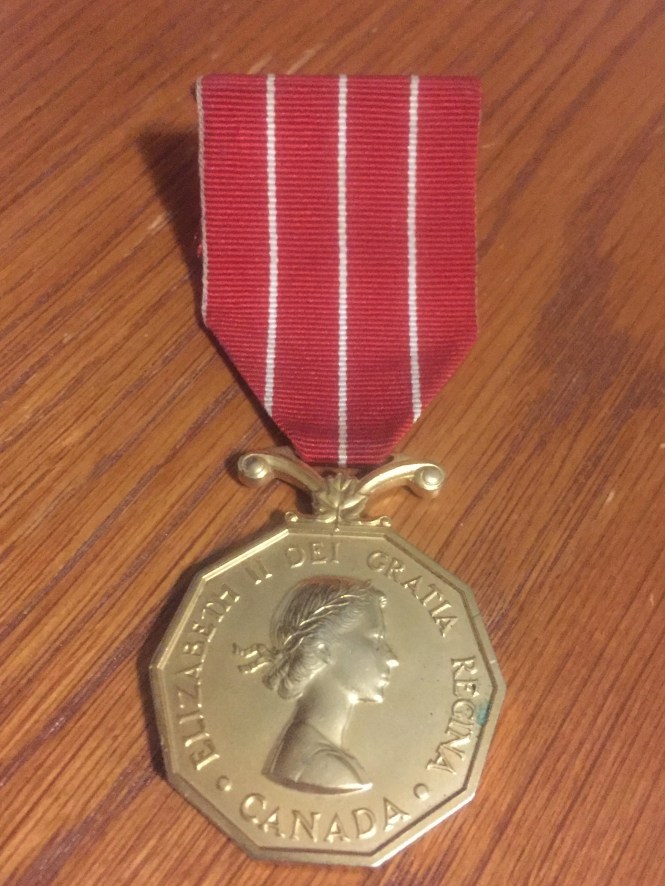
When Canadian Forces Decoration was established in 1951, it consolidated ten different “Long Service Awards” with differing and complex criteria into a singular award with uniform criteria across all military services to include the Reserves. [1] This was not a simple task, for 40 years in the 20th Century, the significant public debate hindered the development of a Canadian Honors system with the exception of the previously mentioned awards for long service! The Canadian Forces Decoration set the foundation for the modern Canadian Honors System.
Originally, the Canadian Forces Decoration was intended to be two separate “long service awards” targeted towards Reserve and Regular forces then debate came about a divide between the officer ranks and enlisted. Major General W. G. Weeks noted that the Army and RCAF “hold the view that in these democratic times there is no basic reason why there should be a different medal for officers than for other ranks. In support of this contention I have in mind that all ranks of all services are eligible for the VC.” [2] Ultimately, King George VI’s intent drove the five year process of creating the Canadian Forces Decoration to be inclusive of all ranks as well as award the post-nomials regardless of rank. In 1950, the Reserve and Regular forces versions were merged and production began on the Canadian Forces Decoration bearing the face of King George VI, designed by Warrant Officer Bernard Reddie, CD. In 1954 the new Queen Elizabeth II medal designed by Captain Bruce Beatty, CM, SOM, CD began to be presented. [3]
The Canadian Forces Decoration is awarded for 12 years of service as a member of the regular, reserve or auxiliary forces of Canada. A gold clasp is awarded for each additional 10 years of service. Since this is a decoration, the name of the recipient is engraved on the bottom of the decagonal medal. The ribbon is red with three thin white lines, symbolic of the official colors of Canada. This medal is named to Corporal D. D. Vjestica, CD.
Mr. McCreery in The Canadian Forces Decoration notes of the simple but distinguished award, “Often the Canadian Forces’ Decoration is looked on as a medal that “comes up with the rations” or is awarded for “12 years of undetected crime”. This self-deprecating attitude towards honours is emblematic of the humility and modesty with which members of the Canadian Forces have discharged their duty for decades. It is an ethos that takes its origins from the Canadian Militia that so ably demonstrated its courage and mettle during the War of 1812 and on numerous occasions since.” [4] I have to say, I have seen on many occasion that self-deprecating humility as Canadian soldiers, sailors, and airmen have served with distinction and honor across the globe!
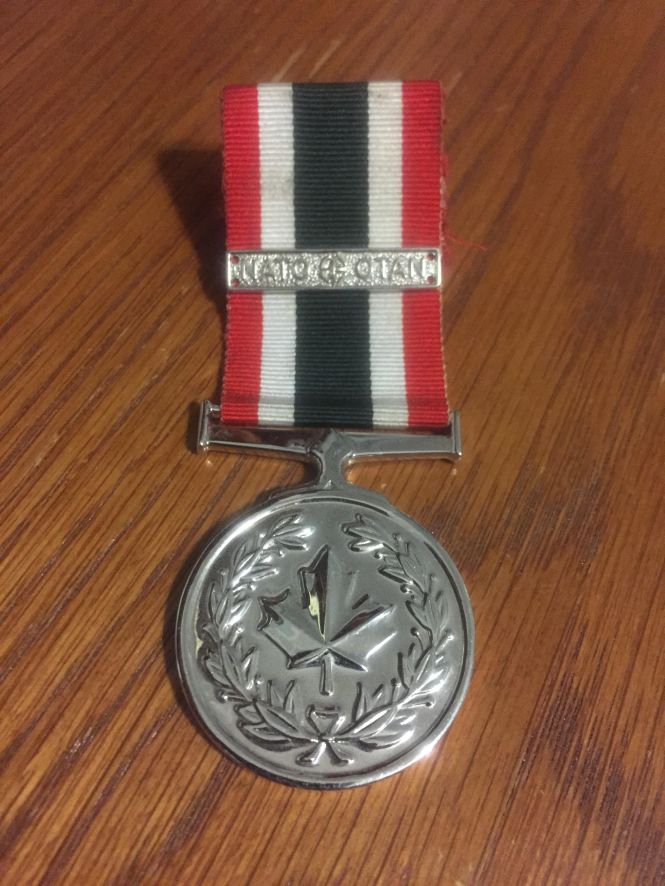
The second medal is the Special Service Medal, awarded to Canadian soldiers, sailors and airmen who “performed a service determined to be under exceptional circumstances, in a clearly defined locality for a specified duration.” It is unclear if this medal belongs to CPL Vjestica or another Canadian. Since 1984, the Special Service Medal has been awarded for activities, deployments and exercises. It is always awarded with a silver bar sewn to the suspense to denote what special service is being recognized. This medal has the “NATO / OTAN” bar attached to its suspense, noting the recipient served 180 days in support of NATO operations or missions not recognized by another medal.
One of the more interesting bars associated with the Special Service Medal is the “Alert” bar, for spending 180 days of honorable service at Canadian Forces Station (CFS) Alert. CFS Alert is the northernmost permanently inhabited location on Earth!
The Special Service Medal with the “Ranger” bar is awarded for 4 years service with the Canadian Rangers, a volunteer service of the Canadian Army Reserves who patrol the sparsely populated areas of Canada.
“Peacekeeping,” “Humanitas” (for Humanitarian Operations,) and “Pakistan 1989 – 90” denote other missions which qualify for the Special Service Medal. “Expedition” is the most recent bar, authorized in 2014. [5]
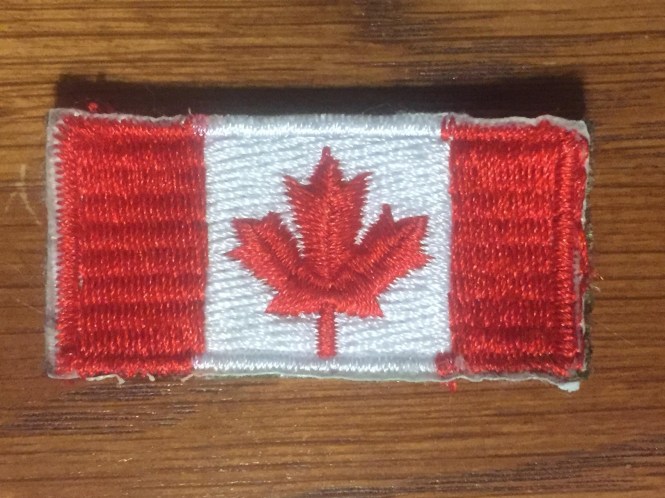
I have proudly served alongside Canadians in the past, and look forward to serving beside them in the future. The patch below is one of two Canadian flags I wore on my uniform when assigned to the 12th Space Warning Squadron. The other hangs proudly in my office.
SOURCES:
- McCreery, Christopher. The Canadian Forces Decoration. Directorate of Honours and Recognition, National Defence Headquarters. Ottawa, ON. Pg. xv
- McCreery, Christopher. The Canadian Forces Decoration. Directorate of Honours and Recognition, National Defence Headquarters. Ottawa, ON. Pg. 25
- Canadian Forces Decoration. National Defence and the Canadian Armed Forces. Accessed Online 30 June 2017. http://www.forces.gc.ca/en/honours-history-medals-chart/medal-cd.page
- McCreery, Christopher. The Canadian Forces Decoration. Directorate of Honours and Recognition, National Defence Headquarters. Ottawa, ON. Pg. xvi
- Special Service Medal. National Defence and the Canadian Armed Forces. Accessed Online 30 June 2017. http://www.forces.gc.ca/en/honours-history-medals-chart/medal-ssm.page
 The Things We Leave Behind