The photo is an old Associated Press photo with the caption typed on a piece of paper glued and taped to the back which reads:
“COL. GERALD R. TYLER, COMMANDANT OF THE SECRET ATOMIC BOMB PROJECT AT LOS ALAMOS, N.M., IS SHOWN AT HIS DESK AT THE OFFICES LOCATED IN MOUNTAINOUS TERRAIN 30 MILES NORTWEST OF SANTA FE.”
But, what isn’t told is the link this photo has to an ROTC legend at my alma mater…..
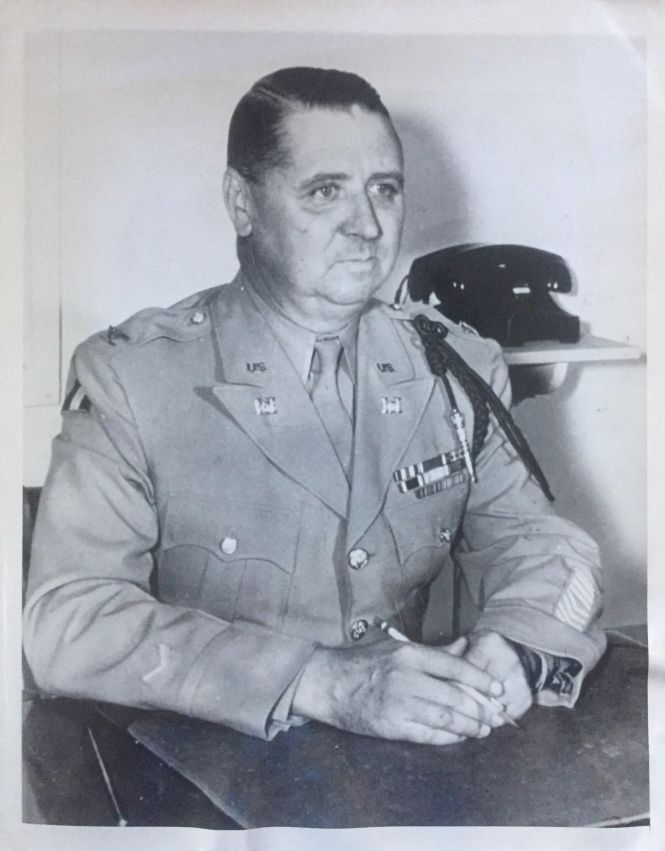
The photo of Colonel Tyler shows a distinguished officer, sitting proudly erect. The branch insignia of an Engineer on his collar. His ribbon rack harkens back to a combat career in the First World War, the Silver Star resting beside the Purple Heart and World War I Victory Medal on the top row. The French Croix de Guerre rests in the second row. World War II Campaign medals are pinned below the older ribbon bars.
Gerald R. Tyler was originally from Windsor, SC. His entry in TAPS, the yearbook of Clemson Agricultural College (now Clemson University) noted, “‘President’ migrated to Clemson in 1911. Since that prehistoric time he has had a most interesting and varied career. After finishing Soph, the lure of the West overcame him, and he found himself shocking wheat on the sunny plains of Kansas.” [1] He graduated with the legendary “War Class” of 1917, but would not have walked at graduation.
The “War Class” of 1917 met on Sunday, April 8, 1917 in Old Main Hall (now named Tillman Hall.) They voted unanimously to offer their services to President Woodrow Wilson “as a whole or individually” for duty during the First World War. [2] Gerald Tyler departed campus with 54 of his classmates on May 3, bound for the first Reserve Officer’s Training Camp at Camp Oglethorpe, GA. [3]
Lieutenant Gerald Tyler deployed as part of the American Expeditionary Force in the 28th Infantry Regiment, 1st Infantry Division. His letters home spoke to the life of the doughboys and brought the horrors of the trenches to life.
In an October 3, 1917 letter to his father, Tyler wrote:
“My party of Americans are attending the Second British Army Anti-Gas school. The work is very, very interesting and the British officers who are teaching us are very competent…. The way the British do in places where they have troops quartered, they go to different houses and request the occupants to vacate certain rooms in the house for officers to stay in, for which the Government pays the owners a good price. The system is arranged that it is usually satisfactory for all concerned. These houses are known as billets. The Americans in my bunch are billeted in different houses, but get our meals in the same house. I am quite comfortably situated with a family of French. None of them speak English except a girl of 17 who speaks it brokenly. At the place where we get our meals there are two girls who speak it very well….
“The section I am in at present is said to be among the most beautiful in France. The whole country is like a picture and they say that before the war, artists used to flock here to paint. The houses are so quaint and odd looking with their brick tapestried walls, and the straw thatched or tiled roofs. The scenery very much like the great paintings show it to be and which I used to think were exaggerated.
“I think I will feel rather sorry to leave this place, although we have a little excitement nearly every night when the weather is clear. The Germans have a nasty habit of coming over and dropping bombs on people’s houses, or as near as they can get. Night before last they dropped several bombs within a quarter of a mile of this house, and the house rocked as if an earthquake had hold of it. They make an awful explosion wherever they hit and I have seen holes in the ground 25 feet deep where the enemy dropped bombs on the ground from planes….” [4]
The letter also describes Lieutenant Tyler’s first trip to the front:
“Today has been quite an eventful one in my young life. Or, rather, I have seen a few things which I have long wanted to witness. Our party went near the front. We went in an automobile early this morning equipped with gas masks, steel helmets on, and with field glasses….
“We went as far as we could in the auto, then got out and walked over a lot of the ground that has been fought over inch by inch, in some of the hardest fighting the world has ever known. We passed over what was a few months ago the British and also the German front line trenches. We were only about a mile behind the British front line, and could see the shells bursting all around. A good many batteries of British artillery kept blazing away around where we were. It was a constant thunder, a deep rumble and shriek all the time. The aeroplanes kept swarming over head as well. I can now say that I have been exposed to shell fire and have seen war.
“Words fail to express how utterly desolate looking that land is that was fought over. It is all pitted and scarred up. Hardly a foot of it remains level, all full of craters and shell holes and filled with debris of every description. Places where there were thick wood are now only splintered stumps with grass and weeds growing between, fertilized by blood and bones, shells, bombs, shrapnel of every description, rotted sand bags, millions of bits of cloth and rags from clothing; human bones – all these things one waded through. I stepped over the decayed carcass of a German. He was half buried by a mine. The thing was lying face down and had its shoes and clothes on yet, and oh, my the smell. The whole battle field was that horrible odor tho…. We went through a town that had been shelled during the war. It is now deserted, not a soul living there, weeds growing all over the streets, and all the buildings (which are not brick) honey-combed or shot to pieces by shell fire.” [5]
Gerald Tyler would fight in the Battle of Cantigny, where the 28th Infantry Regiment would earn the name, “The Lions of Cantigny.” In the photo, his WWI Victory Medal shows the five bronze stars depicting participation in the Champaigne-Marne campaign, the Aisne-Marne campaign, Battle of Saint Mihiel, Meuse-Argonne campaign, and the Defense Sector bar. He still wears the Fourragere of the French Croix de Guerre awarded to the 28th Division.
Lieutenant Tyler left the Army after the Armistice, and became an architect in New York, Philadelphia, PA and Wilmington, DE. He married his wife, Ruth, in 1925. In the late-1930s, Gerald Tyler was recalled to Active Duty as an officer in the Corps of Engineers. He would serve throughout the Second World War working on the development of the Atomic Bombs, which would bring about victory over Japan. [6]
COL Tyler would retire from the military in 1955 and return to his civilian career of architect before retiring a second time in 1970. He died on March 26, 1982 at the age of 87. [7]
I am proud to be fellow Tiger, fellow officer and Colonel Gerald R. Tyler remains a personal hero of mine. Til’ Valhalla, Brother!
Sources:
- TAPS 1917. Printed by Clemson Agricultural College. Clemson, SC. TAPS [yearbook] Records, 1902-1922, Series 509, Special Collections, Clemson University Libraries, Clemson, SC.
- The Tiger. Clemson Agricultural College. April 11, 1917.
- The Tiger. Clemson Agricultural College. May 9, 1917.
- The Aiken Standard. November 14, 1917.
- Ibid.
- “Gerald R. Tyler, Engineer, Dies at 81.” The Washington Post. March 28, 1983. Accessed Online July 14, 2017. https://www.washingtonpost.com/archive/local/1983/03/28/gerald-r-tyler-engineer-dies-at-87/fd8870c7-b7a7-475b-8252-65bd793c74bd/?utm_term=.bc8877765211
- Ibid.
 The Things We Leave Behind