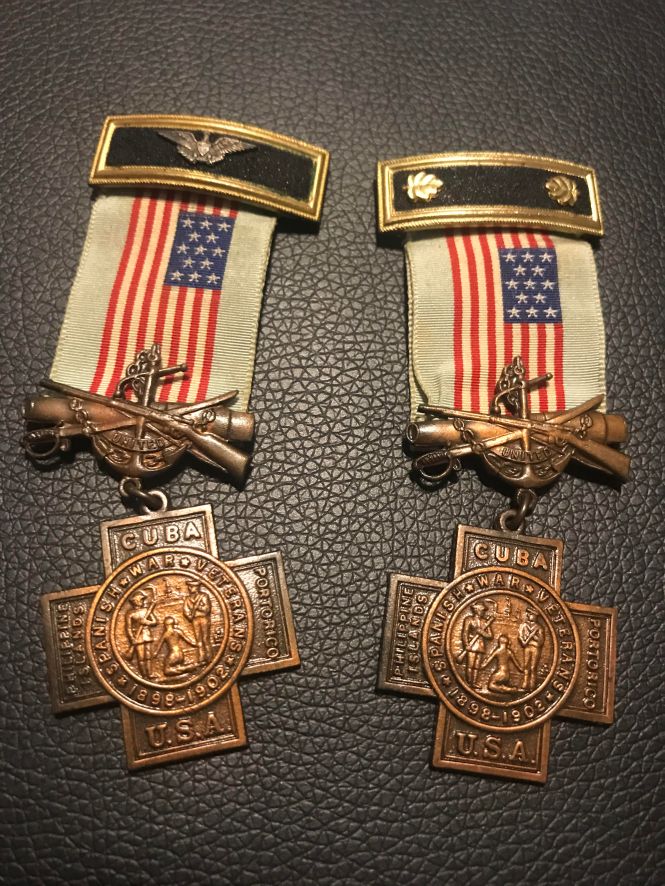
 The Spanish-American War has an interesting role in the greater scope of the American experience. The Civil War was a generational conflict, defining multiple citizen’s experience of conflict. Entire towns were virtually emasculated as their sons and fathers died by the scores. The Spanish-American War though, was by comparison short and relatively bloodless. The impact of the Spanish-American War on society was influential, providing the children of Union and Confederate soldiers to fight side by side.
Returning home, the veterans of the Spanish-American War found themselves in a unique position. They were not deemed eligible for membership in their father’s veteran’s organization, the Grand Army of the Republic (GAR). In 1904, the National Army and Navy Spanish War Veterans, the National Association of Spanish American War Veterans and the National Encampment Service Men of the Spanish War merged to form the United Spanish War Veterans (USWV). The organization would later welcome veterans of the longer, bloodier Philippine-American War as well as veterans of the Boxer Rebellion. [1]
Unfortunately, like the earlier GAR, the USWV limited their membership to the three wars mentioned above and did not extend membership to other conflicts such as World War I, or the banana wars like the Veterans of Foreign Wars or American Legion. This meant the USWV came to an end when Lieutenant Nathan E. Cook died in 1992. LT Cook served a 44 year career in the U.S. Navy and was a veteran of the Philippines Insurgency, Boxer Rebellion, and both World Wars. [2]
The medal is a bronze Greek cross with three figures in the center surrounded by a ring reading “Spanish War Veterans 1898 – 1902.” On each arm of the cross is the main theaters of the Spanish-American War Philippine Islands, Cuba, Porto Rico, and U.S.A. on the bottom. The medal is suspended from a bar depicting a rifle and saber crossed over a cannon and anchor with the scroll “United.” The reverse of the cross has the United States Shield with the world “United” superimposed, encircled by the insignia of the Cavalry, Artillery and the eighteen Infantry corps whose men served in the Spanish-American War. [3]

The two medals are suspended from a distinctive ribbon with a stylized American Flag. The light blue stripes on the outside of the ribbon indicate the medals are representative of a Camp Officer. The medals are suspended from bars stylized over the period rank straps worn on the shoulder denoting the owner’s rank within the camp. The silver eagle of a Colonel for the Camp Commander and the gold oak leaves of a Major for the Junior Vice Commander.

The importance of these medals as artifacts is multifaceted. First and foremost, they are relics of an often forgotten war. The creation of medals such as these were important to veterans who predated the U.S. custom of striking campaign medals; because it recognized their service.
SOURCES:
- Constitution and Rules and Regulations of the United Spanish War Veterans 1920. R.S. Peck & Co. Hartford, CT. Pp XIV – XV.
- “Nathan E. Cook, 106; America’s Oldest Known War Veteran.” L.A. Times. 12 Sep 1992. https://www.latimes.com/archives/la-xpm-1992-09-12-mn-288-story.html Accessed online 12 Jun 2019.
- Weaver, Barry C. “Observation son United Spanish War Veteran’ Medals. Part I: Membership, Officer, and Past Officer Medals.” Journal of the Orders and Medals Society of America. Vol. 54. No. 6. Nov – Dec. 2003. Pg. 3.
 The Things We Leave Behind