The medals were unnamed, but the grouping came with extensive paperwork attributing them to John George Ward, Jr. A man whose story is full of courage and sacrifice, but also serves as an example of how chance guides you towards your destiny.
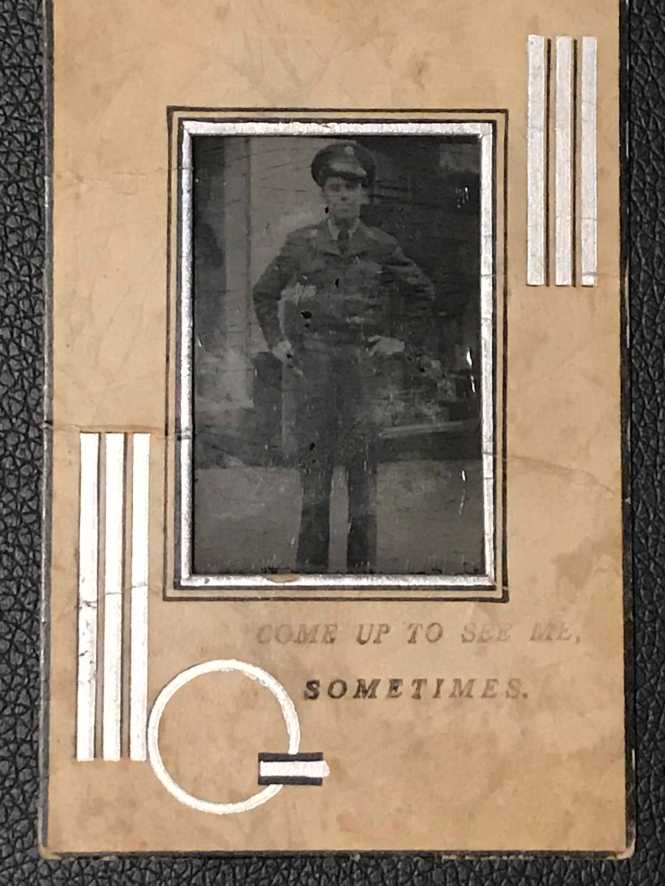
John G. Ward, Jr. as an enlisted soldier
To put a significant part of this story into context, for the non-veteran, the officer’s commission must be put into context. Commissioned officers make up approximately 10% of the U.S. military. The commissioned officer’s authority is derived from Article II, Section 3 of the U.S. Constitution. Supreme Court Justice John Marshall wrote in 1803, “granting a commission is the distinct act, done in the name of the President, which empowers an officer.” [1]
When the U.S. entered the Second World War in 1941, John G. Ward was living with his wife, Marguerite in Kansas City, Missouri. A class of 1930 graduate of the University of Pennsylvania, [2] he was working for La France Industries as a salesman. Born in New Jersey, he had at some point headed west. [3] He registered for the draft on October 16, 1940. [4]
According to the original documents included with the medals, John Ward was applying for a commission in the U.S. Naval Reserve and received a letter on June 9, 1942 stating that his application had been accepted by the Office of Naval Officer Procurement in Chicago, Illinois. [5] On June 11, Lieutenant Commander J. L. Clarkson wrote to Local Board No. 7 requesting his induction into the U.S. Army be postponed until it was determined whether John Ward would be commissioned. [6] On June 23, the Bureau of Naval Personnel responded to John’s application. “You are advised that, after careful consideration, the Bureau is unable to approved your application for appointment in the U.S. Naval Reserve.” The reasons indicated in the letter were listed as a lack of vacancy and inability to meet naval physical requirement. [7]
While the Navy was determining if John Ward was to be commissioned as an officer, the U.S. Army had inducted Private John G. Ward into the U.S. Army on June 12, 1942 at Fort Leavenworth, Kansas. He stood at 5 foot 10 ½ inches tall and is listed as having brown eyes and brown hair that was beginning to gray. Rapidly, John Ward was distinguished as an exceptional soldier. He rose to the rank of Staff Sergeant and his specialty was listed as “First Sergeant” indicating he was serving as the highest ranking non-commissioned officer in Headquarters Company, 3rd Battalion, 47th Infantry Regiment one year, one month later. [8]
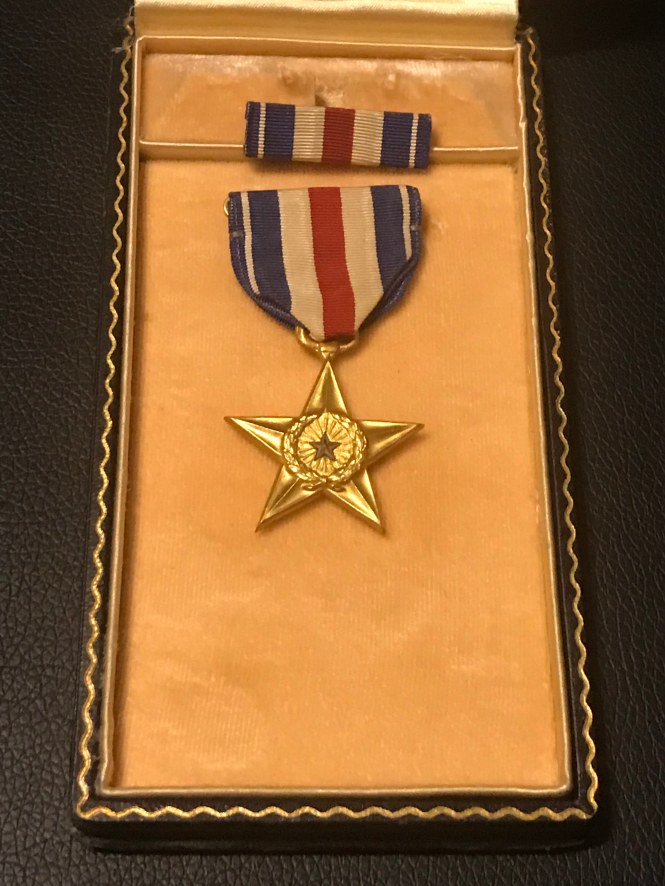
Silver Star Medal attributed to John G. Ward, Jr.
Private Ward took part in Operation BLACKSTONE (a part of the larger Operation TORCH) fighting against Vichy French forces during the battle of Safi from November 8 – 11. After an extensive foot march across North Africa, Private Ward fought with the 47th Infantry Regiment in the Battle of El-Guettar, Tunisia from March 23 – April 8, 1943. [9] After three days of hard fighting during the battle, Private Ward received permission to accompany the assault platoon in attacking the battalion objective. The Restricted Silver Star Medal citation published of the account reads, “Private Ward’s aggressive attitude, action and leadership, contributed greatly to the success of the attack, not only at this time but during the entire battle period from the 23rd of March to the 8th of April.” [10] On the final day of the battle, Private Ward received a shrapnel wound on his lip, earning him his first Purple Heart.

Purple Heart Medal attributed to John G. Ward, Jr.
On August 1, the 47th Infantry Regiment landed on Sicily as part of the Allied invasion and campaign on the Mediterranean island. In the backdrop of this pivotal military campaign, Staff Sergeant John Ward was about to undergo a significant milestone in his life. On August 3, Staff Sergeant John G. Ward Jr. was discharged from the U.S. Army. [11] Headquarters, Seventh Army published the Battlefield Appointment (more commonly referred to as a Battlefield Commission) on August 4, 1943. “Private John G. Ward, Jr.* …. having demonstrated outstanding ability to command in actual combat, is hereby temporarily appointed a Second Lieutenant, Army of the United States, effective 4 August 1943.” The order ends, “By Command of Lieutenant General PATTON.” [12] Lieutenant Ward finally had the commission he desired, and had earned it in the most challenging way possible, and was assigned to Company C, 47th Infantry Regiment. [13] With the increase in pay, Lieutenant Ward created a new pay allotment for his wife, Marguerite who was living in Inglewood, California at the time with the sum of $200 a month of his salary going directly to his wife. [14]
Following their actions on Sicily, Lieutenant Ward was transferred with the rest of the 47th Infantry Regiment to England, in preparation for Operation OVERLORD; the invasion of mainland Europe. The veteran of two invasion forces would be one of the pivotal battlefield leaders for the 47th Infantry Regiment. While in England, the men of the 47th Infantry would receive some much deserved “R&R.” Two V-Mail letters from this time are preserved.
On November 12; Mr. Harry G. Ward wrote to John about a request for some Abercrombie and Fitch sleeping bags and provided some words of encouragement.
“As soon as I received your letter and the certificates I went to the Abercrombie & Fitch Company in New York and was fortunate in finding two of the bags. The last two in fact. Your letter and the certificates closed the deal and shipment of the two bags were made. When I returned from New York I shipped the rubber mattress to them and they prepared it for shipment…. I certainly hope all will be received in good time and condition, and introduce into your life some of the comforts you so richly deserve….
“We are all very happy about the progress of the war and wonder why our enemies do not accept the inevitable and quit, and allow constructive forces to again hold sway in the world.
“On the home front, it is true that there are occasional disturbances because of strikes and seeming indifference, but on the whole I feel sure that the entire country is doing its share and there is no let down in war production or other activities contributing to your support.” [15]
Lieutenant Ward spent early 1944 assigned to Headquarters Company. [16] In late January, Lieutenant Ward led the Regiment’s boxing team in a match against the British Army’s Hampshire Regiment, “The Hampshire Tigers.” A British officer wrote Lieutenant Ward a congratulatory letter on January 28.
“I would like to congratulate you and the whole of your Boxing team on the excellent spirit in which they fought each contest last night against a more experience and fitter team. In every fight in spite of every decision going against them every man fought his best for his side and I considered it a great sporting effort.” [17]

From Left to Right: Good Conduct Medal; European, African and Middle Eastern Campaign Medal; and World War II Victory Medal attributed to John G. Ward Jr.
Lieutenant Ward would take part in the Normandy Invasion and continue to serve with the 47th Infantry till the end of the war. He would later serve in Korea, and rise to the rank of Major. After his military career, he worked as a credit manager for Quilt Crafters Company in Dallas, Texas. He passed away in Irving, Texas on August 21, 1973. [18]
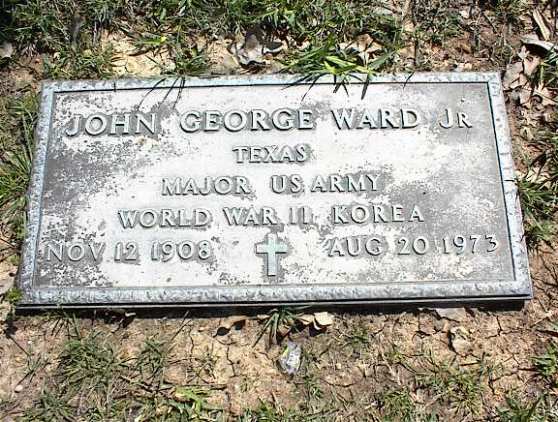
(Photo Courtesy of https://www.findagrave.com/memorial/22310288/john-george-ward)
* The discrepancy in rank is likely due to bureaucratic lag between the 47th Infantry Regiment headquarters, 9th Infantry Division headquarters, and 7th Army Headquarters.
Sources:
- Bray, Bill, Captain, USN (Retired.) “Know What an Officer Commission Means.” Proceedings. U.S. Naval Institute. Oct 2017. Accessed online, 15 Jun 2019. https://www.usni.org/magazines/proceedings/2017/october/know-what-officer-commission-means
- “Obituary, Graveside rites for J.G. Ward.” Irving Daily News. 22 Aug 1973. Pg. 16
- Ancestry.com. 1940 United States Federal Census [database on-line]. Provo, UT, USA: Ancestry.com Operations, Inc., 2012.
Original data: United States of America, Bureau of the Census. Sixteenth Census of the United States, 1940. Washington, D.C.: National Archives and Records Administration, 1940. T627, 4,643 rolls.
- Ancestry.com. U.S. WWII Draft Cards Young Men, 1940-1947 [database on-line]. Lehi, UT, USA: Ancestry.com Operations, Inc., 2011.
Original data: The National Archives in St. Louis, Missouri; St. Louis, Missouri; WWII Draft Registration Cards for Missouri, 10/16/1940 – 03/31/1947; Record Group: Records of the Selective Service System, 147; Box: 340
- Zimmerman, D. C. to Mr. John George Ward. NOPC 71467-42. 9 Jun 1942.
- Clarkson, J. L., Lieutenant Commander, USNR CCed to Mr. John G. Ward. NOPC-103-mc-73716-42. 11 Jun 1942.
- Jacobs, Randall to Mr. John G. Ward. Pers-3651-TEJ. 23 Jun 1942.
- John G. Ward Jr. Honorable Discharge from the Army of the United States. Signed George W. Smith, Colonel, USA. 3 Aug 1943.
- Ibid.
- 9th Infantry Division General Order 77. 17 Sep 1943.
- John G. Ward Jr. Honorable Discharge from the Army of the United States. Signed George W. Smith, Colonel, USA. 3 Aug 1943.
- Caldwell, W. G., Lt Col, AGD to Commanding General 9th Infantry Division, APO 9. Subject: Battlefield Appointment. 4 August 1943.
- Special Order 60. Headquarters, 47th Infantry Regiment. 14 August 1943.
- Authorization of Allotment of Pay. 21 August 1943.
- Harry G. Ward to John G. Ward, Jr. Sent via V-Mail. 15 November 1943.
- Special Order 3. Headquarters, 47th Infantry Regiment. 7 January 1944.
- Unknown to Lieutenant Ward. 28 January 1944.
- “Obituary, Graveside rites for J.G. Ward.” Irving Daily News. 22 Aug 1973. Pg. 16
 The Things We Leave Behind