Fifty years ago today, three brave Americans blasted off from Cape Canaveral, Florida. They were undertaking a challenging adventure, which only the American people have accomplished to this date. Neil Armstrong was the mission commander, a former Naval Aviator and test pilot. A veteran of the Korean War, he was previously the command pilot of the Gemini 8 mission. Joining him in the lunar module named Eagle, was Air Force officer and fighter pilot Edwin “Buzz” Aldrin Jr. “Buzz” Aldrin was also a veteran of the Korean War, having been credited with two aerial victories over communist MiG-15s. He had previously flown into space on the Gemini 12 mission. On the command module, Columbia, was Air Force officer and test pilot Michael Collins, a veteran of the Gemini 10 mission. The mission patches – like the exterior of the white space suits – from Apollo 11 were made from a “space age material” called beta cloth.
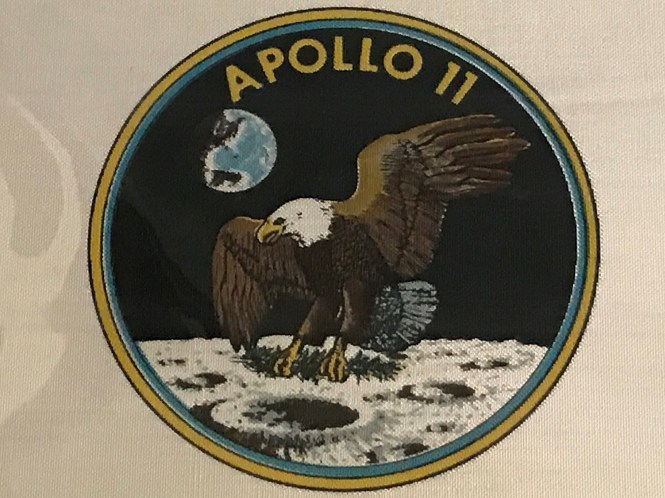
Beta cloth was utilized in spacecraft after the Apollo 1 disaster that ended manned space travel for over a year. The second finding in the Apollo 1 accident investigation stated, “The Command Module contained many types and classes of combustible material in areas contiguous to possible ignition sources.” [1] Beta cloth, having been developed five years prior by the Owens-Corning Fiberglas Company became a principle material in the new Apollo space suits. Beta cloth was being used in the manufacture of fire-proof draperies until NASA contracted with Owens Corning to produce the space suits for the Apollo 7 mission marking the return of manned spaceflight. Beta cloth is also used extensively in spacecraft to this day to provide fire resistant insulation on non-metallic surfaces. [2] Describing the new space suits, “It has an outer layer of Beta fabric – which, flame tests show, has 10 times the fire resistance of the old nylon.” [3] Stanley Collins of Owens-Corning Fiberglas Company stated, “NASA selected beta cloth because it can’t burn, even in the pure oxygen atmosphere of the space craft…. The fabric won’t stretch, shrink, absorb moisture or rot, and its outer layers are not affected by the extreme temperatures on the moon – varying from 250 degrees above zero to 250 below.” [4]
The significance of the mission patch as a cultural artifact is highlighted by the fact that at President Richard Nixon’s state dinner on August 13, 1969; he presented a beta cloth mission patch to each of the 1,440 attendees. [5] A “New Old Stock” supply of Apollo 11 mission patches from the Roma Chemical Company were discovered and hit the collector market in approximately 2017. Even in the issued materials, the advertising of the technology was evident. “Printed with Roma Questral Space Age Pigments on Owens Corning Beta Fiberglas.”

As alluded to earlier, this was not just a heroic accomplishment of the three astronauts who flew the mission; but a national triumph as well. Americans across the nation took pride in their small part contributing to this mission. One example of this is from The Greenville News:
“When Astronauts Neil Armstrong and Edwin Aldrin take those historic first steps on the moon, a little bit of Anderson [South Carolina] will be present, playing an important role in protecting the men from whatever hazards might exist.
“They, as well as Astronaut Michael Collins in the spacecraft above, will be wearing suits made from beta cloth, a product of Owens-Corning Fiberglas Corp.
“The Anderson plant began making beta yarn about five years ago….
“Employees of the Anderson plant will be following the moon landing with the utmost attention, knowing they had a part in the historic event.” [6]
The Apollo 11 mission today remains a point of national pride for the United States, and should.
This is part 1 of a 3 part series on artifacts commemorating the Apollo 11 mission. Please check back as I review two other artifacts and different aspects of the history of the NASA program and Apollo mission.
SOURCES:
- Dr. Floyd L. Thompson (Chairman); Frank Borman, Col, USAF; Dr. Robert W. Van Dolah; Dr. Maxime A. Faget; George C. White, Jr.; E. Barton Geer; John H. Williams; and Charles F. Strang, Col, USAF. Report of Apollo 204 Review Board to The Administrator National Aeronautics and Space Administration. National Aeronautics and Space Administration. 5 Apr 1967. Pg. 6-1
- Liverance, Sara V. “Anderson Cloth To Protect Astronauts On Moon Walk.” The Greenville News. 17 Jul 1969. Pg. 34
- Ditzel, Paul. “The Inside Story.” Popular Science. Vol. 191, No. 5. Nov 1967. Pg. 98
- Cassidy, Shelagh. “Lunar Fashion Will be Shown.” The Newark Advocate. Newark, Ohio. 6 Oct 1970. Pg. 1
- “NASA Likes OCF’s Beta Cloth.” The Waxahachie Daily Light. Waxahachie, TX. 19 Aug 1969. Pg. 8
- Liverance, Sara V. “Anderson Cloth To Protect Astronauts On Moon Walk.” The Greenville News. 17 Jul 1969. Pg. 34
 The Things We Leave Behind