When the guns fall silent, and the war ends, sometimes warriors from opposing sides meet without animosity. Private Sward, of the 726th Medical Detachment, 71st Medical Battalion documented one such firsthand account of a Japanese soldier during the Battle of Okinawa in a letter home on December 14, 1945.

Operation ICEBERG would be the largest amphibious operation in the Pacific theater triggering the 82 day Battle of Okinawa. The Battle of Okinawa had strategic significance to both the Japanese and American militaries. For the United States, Okinawa was crucial to their execution of Operation DOWNFALL, the planned invasion of the main Japanese home islands. The Japanese military understood they had to convince the United States that an invasion of the Japanese homeland would be a bloody endeavor, with significant casualties on both sides. Okinawa was to be an example of that cost.
The Okinawa Prefectural Peace Memorial Museum lists the total casualty count as follows. The names of all 241,566 casualties are listed on the Cornerstone of Peace Memorial there. [1]
149,529 Okinawans
77,448 Japanese citizens from other prefectures
14,009 U.S. Soldiers, Sailors, Airmen, Marines and Coast Guardsmen
82 United Kingdom citizens
34 Taiwanese citizens
382 citizens of the Republic of Korea
83 North Koreans
Less than six months after the end of the battle, Private Sward meets a Japanese or Okinawan soldier who is now working with the Americans of the 71st Medical Battalion. He writes home to his family of the encounter, and describes how this former soldier was injured in the pages below. (Grammatical errors in the below transcription are kept for accuracy in Private Sward’s words.)
“Yesterday I talked with a Jap working in our tent. He had been in the Surri line just outside of Naha. He seen Naha and the 25th where I had drawn in some ridges (I drew myself a map of Okinawa) and he drew charts and showed me where he fought. On my little notebook I drew a map like this

“The way I understood him was that the Surri Line was to the left of Chocolate drop (I’ll find out for sure when I get home and get a map showing the battle area.
“I guess he was in the Surri and when the Marines came he went to Sawtooth. In the battle he got hit by hand grenade fragments. He show me his private fight in diagram
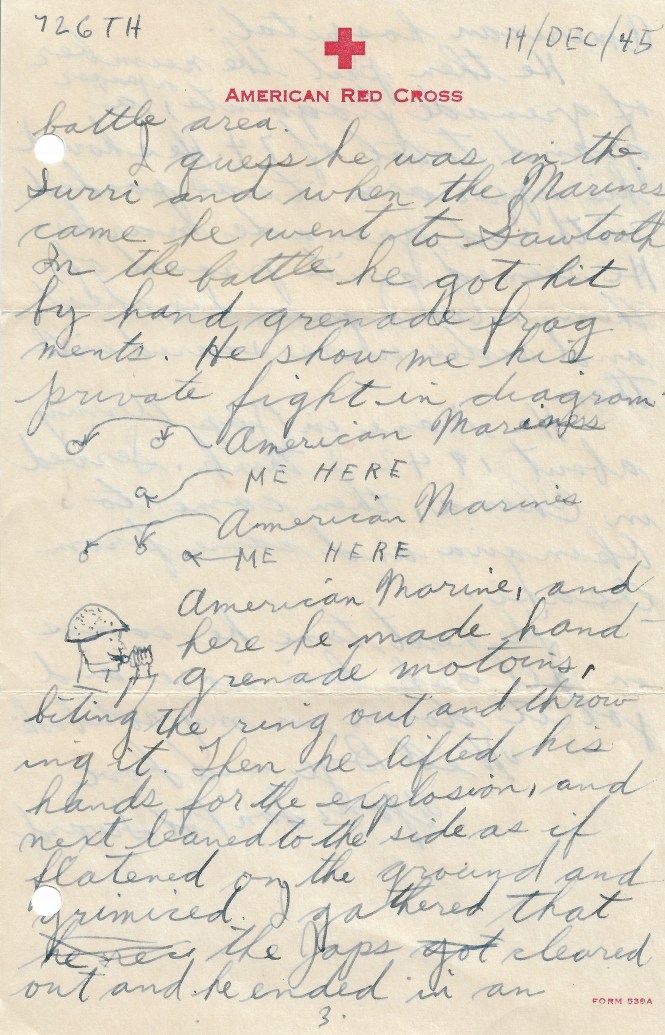
“American Marine and here he made hand grenade motions, biting the ring out and throwing it. Then he lifted his hands for the explosion, and next leaned to the side as if flattened on the ground and grimiced. I gathered that the Japs cleared out and he ended in an American hospital.
“He then put the number of grenade fragments on paper, a grand total of 74. He showed his upper arm it was pocked with red grenade marks. He seemed quite proud of them, also guess his chest and sides were scared with them.
“He came in Jap Army about 1942 I think. Served in China, then came to Okinawa and came from Asaki.
“The next time he comes in I’ll ask him more and jot it down in my notebook.”
A veteran Japanese soldier, found employment with the U.S. military in the days after the Second World War. What impact did the mercy, of being taken to a U.S. hospital after being wounded in battle have on him? But, the serendipity, of a Private writing his tale down; preserved it for generations to come. We are not the owners of artifacts such as this, but simply the stewards of it for generations to come.
SOURCES:
1.) The Cornerstone of Peace Website. https://www.pref.okinawa.jp/site/kodomo/heiwadanjo/heiwa/7812.html Accessed February 13, 2020.
2.) Private (First Name Unknown) Sward. Letter home. December 14, 1945.
 The Things We Leave Behind