
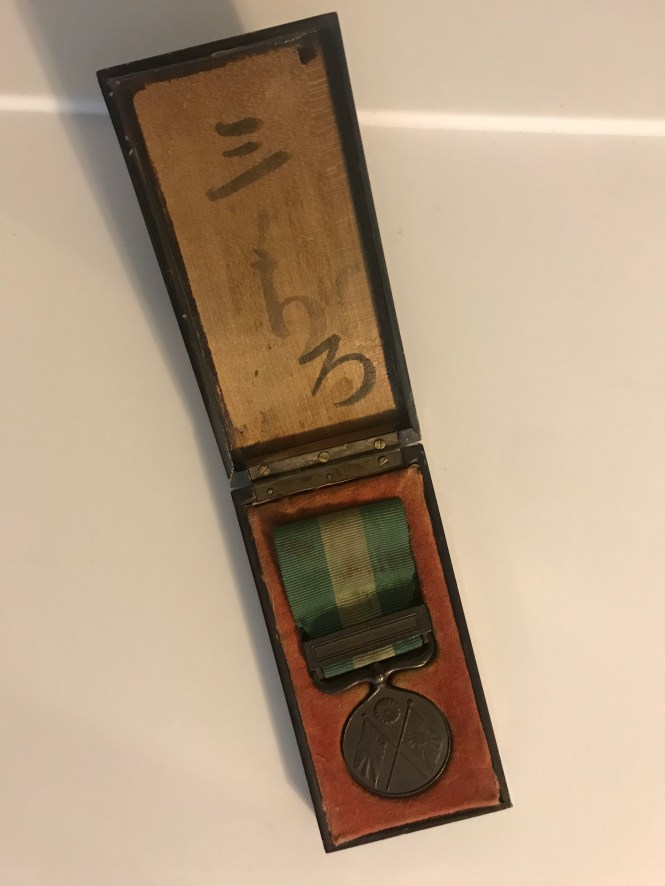
The chocolate bronze medal was in a century old black enameled kiri wood box. Resting in a faded red velvet bed, the obverse shows the Imperial Mon (or crest), a Chrysanthemum, superimposed between two “Rising Sun” flags of the Japanese Empire. The medal is suspended by a bar from a ribbon of light green with a lighter, almost white green stripe down the center. On the reverse of the medal in four Japanese characters is the title, “Commemorative medal for service in the war.” The inscription around the edge of the obverse reads, “Meiji twenty seventh through eighth years” or 1894 – 1895 in the Julian calendar. The medal commemorates the Sino-Japanese War.
The Meiji Era ran from 1868 until the death of the Emperor Meiji and the ascension of Emperor Taisho in 1912. Viewing Korea as a strategic interest to the Japanese nation because of its proximity, the Meiji government had come to an agreement with the Qing dynasty in the Tientsin Convention that required both nations to inform one another before any military intervention on the Korean peninsula. When China sent soldiers to Korea to suppress the Donghak rebellion, Japan viewed it as a violation of the Tientsin Convention.
Western analysts predicted a Chinese victory over the smaller Japanese military when war broke out between the two nations in 1894. The Japanese at large also viewed China as a regional powerhouse. Keene notes in his essay “The Sino-Japanese War of 1894 – 1895 and its Cultural Effects in Japan”:
“The defeat of China in the Opium War naturally revealed to the Japanese how much weaker militarily China was than a European power like England, but the tradition of respect for the Chinese military strength was not easily shattered. Most Japanese of 1890 believed China was a powerful country.” [1]
That observation that a European power’s superiority to the Chinese military of the era would prove prophetic, in the westernized Japanese army’s performance in the War. Emperor Meiji instituted radical changes in the feudal Japanese society (known as the Meiji Reformation) rapidly instituting an industrial revolution and modernization of the Imperial Japanese Military. Initially using a French model, by 1885 the Japanese Imperial Army had adopted a German model conscript army. The Imperial Navy, while not yet capable of fielding battleships, employed a “Jeune Ecole” or “Young School” doctrine, where smaller, faster craft could outmaneuver and overwhelm larger capital ships.
The Japanese military had significant advantages over the Chinese military at the time. Unified command and control structures, Western training and doctrine which led to several military victories for the Japanese. After Chinese forces fled Korea, the Japanese military continued to press Chinese forces offensively. At the battle of the Yalu River (1894) for example, a smaller Japanese naval force decisively defeated a superior Chinese force, the Beiyang Fleet, sinking five ships.

The war ended with the Treaty of Shimonoseki on April 17, 1895. The Qing Empire was forced to recognize Korean independence, ceded significant territory to Japan “in perpetuity” to include the Liaodon Peninsula, Taiwan and the Penghu Islands, and paid in excess of 17,000,000 pounds of silver as war reparations. Russian, German, and French intervention later saved the Liaodong Peninsula for China by having Japan exchange it for additional silver reparations.
As Americans, it is easy to fall into a Eurocentric or American-Centric view of the world. Artifacts such as these remind us that there is an entire globe of history we forget when we view the world in that fashion. Additionally, there are lessons to be learned from the Sino-Japanese war for strategic decision makers. The industrialization and militarization 20 years prior led to the Japanese ability to defeat China in the war. The dividends sometimes do not pay off for strategic decisions for decades.
SOURCES:
1.) Keene, D. “The Sino-Japanese War of 1894 – 1895 and its Cultural Effects in Japan.” Meiji Japan: Political economic and social history 1868 – 1912. Ed. Kornicki, Peter. Vol. III. Routland Press. London. 1998. Pg. 250
 The Things We Leave Behind