When the Name Tag tells the Bronze Star’s Story

img_6704

The Bronze Star Medal held a nice beautiful chocolate patina and was in a pristine plastic presentation case from the 1950s and 1960s era.  It was eye catching, with the initials D.C.K. engraved on the back.  This would have meant the recipient would have been unknown and lost to time.  Except for the metal U.S. Air Force name tag to D. C. Kipfer with the Warfare Systems School insignia pointed to an exceptional Air Force Colonel’s Service that spanned from World War II through the Vietnam conflict.  What initially looked to be a story of a singular wartime achievement instead told a story of a man whose contributions in Research & Development had greater strategic impact on the United States Air Force.  This is Colonel Donald C. Kipfer’s story of service.
Continue reading

A tipping point in my personal “history”

Today marks 16 years since I took my Oath of Office and accepted a commission as a 2nd Lieutenant in my beloved Air Force.  Today marks the point where I have guaranteed fewer years ahead of me in my career than behind me as I continue the march to retirement.  I took this photograph several months back, to highlight the history of my beloved Air Force.  It brings me comfort to think that I have left my fingerprints on the history of the world, my nation, and my Air Force.

A rich heritage and an even brighter future…..

AF History

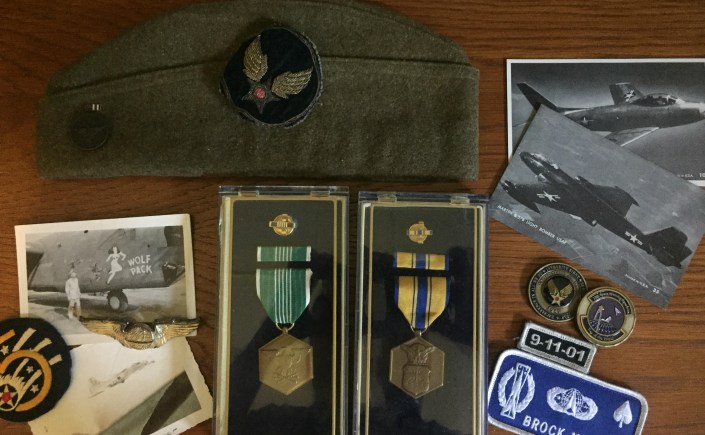
From bottom left corner, clockwise:

    • World War II Navigator “Wings” and an Australian made 5th Air Force Patch on top of European Theater photographs .
    • Overseas Hat from the immediate Post-World War I era Air Service with a World War II-era Bullion “Hap Arnold” Air Forces Patch (top)
    • 1950s Air Force Post Cards (top right corner)
    • The Airman’s Coin I was presented when I was commissioned with the coin of the 12th Space Warning Squadron (my first assignment.)  The 9/11 memorial tab and flight suit name patch for my time with the 10th Missile Squadron.
    • An Army Commendation Medal awarded to M/Sgt Cedric V. Smith and an Air Force Commendation Medal awarded to Maj Lindon E. Strand.  The clear plastic cases were used in the 1950s and 1960s.


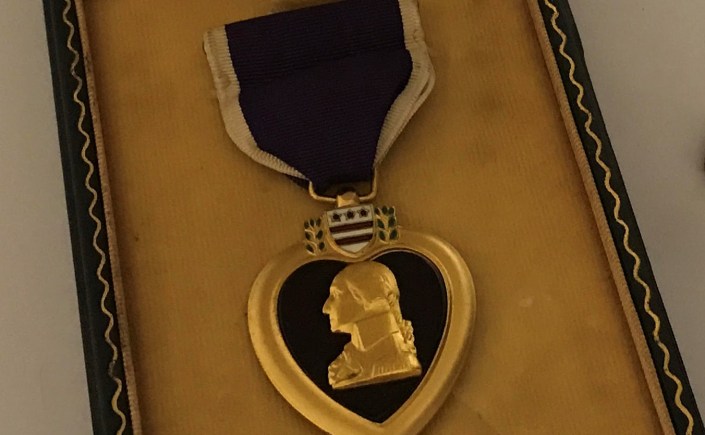
Royal’s Purple Heart

It has been the study of the “great men” which most historians have focused on.  The generals (such as George Patton) who guided armies (such as Third Army) through pivotal moments in great wars have been the focus of most historians’ studies.  But among those armies are the microhistories which have shown relatively “minor” men can leave their fingerprints on the course of humanity.  The artifacts left behind are evidence of these microhistories.  Personally, I feel a calling to tell these stories of my brothers in arms.  One such calling hit me on our family vacation last week.  The Purple Heart that belonged to Private Royal Gaunt spoke to me from the moment I first saw it.  This is the story that emerged from that near seventy year old medal.

Continue reading

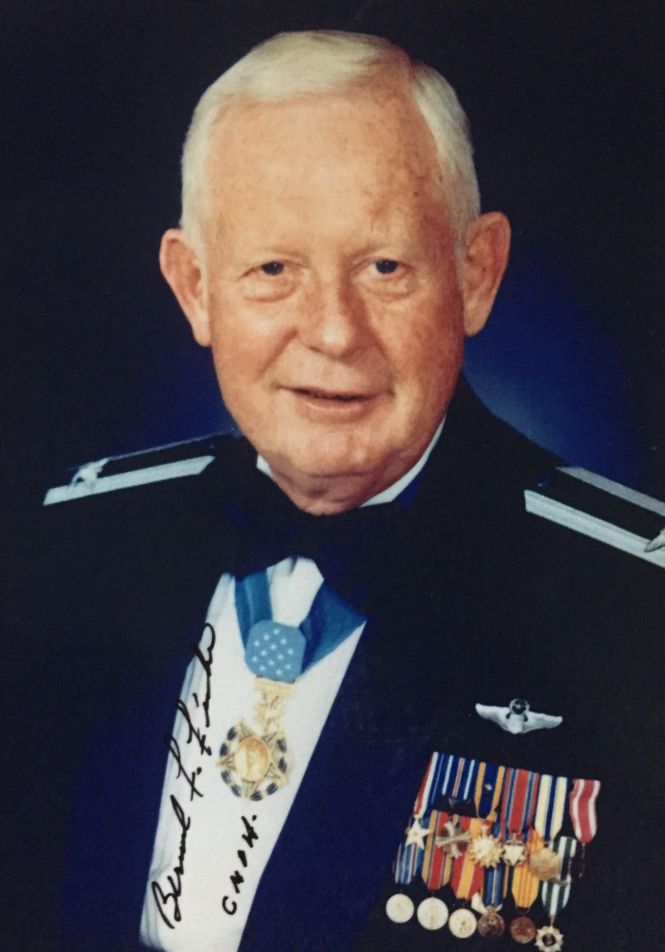
The Medal of Honor Presented on January 19, 1967…..

I have recently began collection militaria connected to the Medal of Honor.  I currently have signatures from three recipients in my collection, and my first program from a Medal of Honor ceremony.

The Medal of Honor holds a special place in U.S. military lore, and for good reason.  It is the second oldest U.S. military decoration* and was established when President Abraham Lincoln signed into law the Navy’s Medal of Honor.  Today, there are three distinct designs for the Medal of Honor.  It remains the nation’s highest award for military valor.  These artifacts (pictured below) speak directly to the history of the most recent design, the Medal of Honor awarded by the U.S. Air Force.

B_F_Fisher

Continue reading

“Eye Deep in Hell” gives birth to the Trench Knife

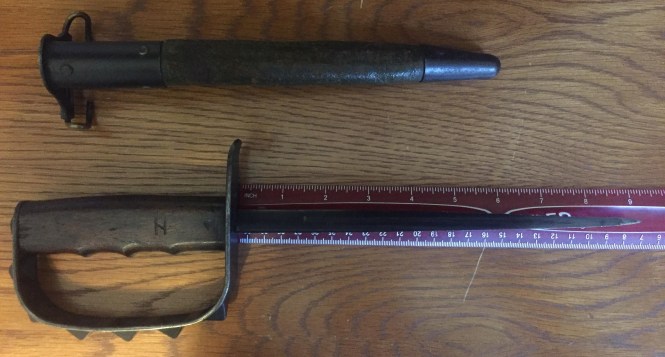
It is the kind of horrific weapon only a war can produce.  The blade is triangular in shape and extends slightly over 9 inches from the hand guard.  It is crafted to pierce clothing and leather with ease, and easily penetrate deeper in the man beneath those clothes with minimal friction on the blade.  The guard extends around the wooden grip, with raised triangular knobs to focus the pressure of a punch with bone crushing results while protecting the hand.  It is a Model 1917 Trench Knife.  And despite its horrific capabilities, the men of the American Expeditionary Force (AEF) found it lacking in combat efficiency.

Mod_1917

Continue reading

IYAOYAS! An Aviation Ordnanceman in the middle of Japanese Attacks

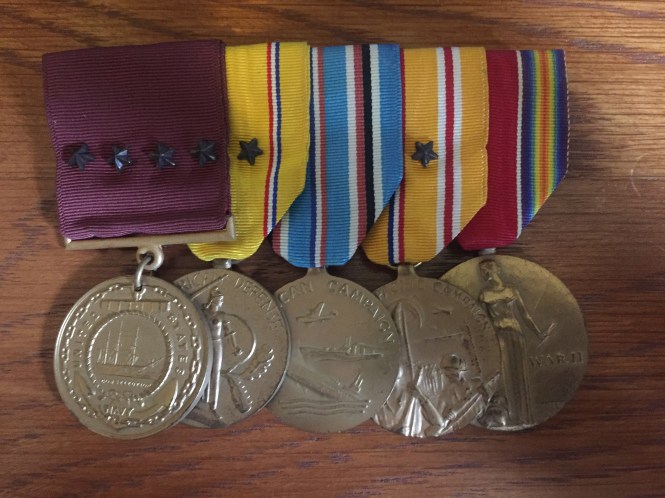
The Good Conduct Medal was named to Robert E. Barnhart and dated 1942, and came on a mounted medal bar.  The regulations and history of the medals themselves tell both the story of the medals and when and how the recipient earned the medal.  But, who was Robert Barnhart?  And if the medals and ribbons a service member receives tells the story of their service, what story does this medal bar tell?  The story that follows takes us to the early days of World War II in the Pacific, and a man whose life these events swirled around.

Barnhart_Medals_Front

Continue reading