On November 11, 1919, President Woodrow Wilson dedicated Armistice Day, which would later evolve into the modern National holiday Veteran’s Day with these words. “To us in America, the reflections of Armistice Day will be filled with lots of pride in the heroism of those who died in the country’s service and with gratitude for the victory, both because of the thing from which it has freed us and because of the opportunity it has given America to show her sympathy with peace and justice in the councils of the nations.” But across the nation, families were mourning their lost loved ones.
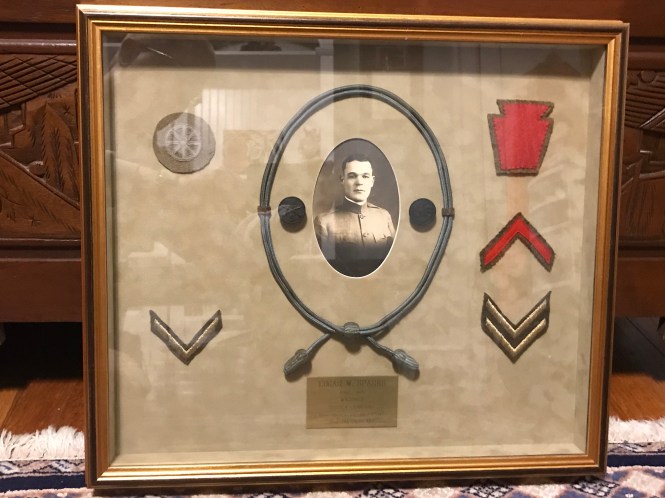
When I first found this shadow box in an antiques store in Lewisville, Texas; my thought was “Who will remember Wagoner Edgar Sparks, a century after he gave his life for his country?” As I began to research Edgar’s life, I realized the story was much more nuanced than that initial thought.
Edgar W. Sparks was born in February 1892 in Oklahoma to James and Ada Sparks. He grew up in Headrick, Oklahoma – a small town near modern day Altus Air Force Base – in the southwest of the state. [1] By the 1910 census (apparently taken in 1908 in this part of the country), his family had filled out with the births of his sisters Bertha, Susie, Ruby and Ada and brothers Ernest and Emery. His mother though, sadly passed shortly after the birth of Ada in 1907. Edgar, able to read and write, was working odd jobs as a laborer to help support his family. [2]
Tall and slender, with brown eyes and black hair; the young man went by “Edd.” When the United States entered the First World War, “Edd” registered for the draft on June 5, 1917. [3] He departed for service with the American Expeditionary Force as a Wagoner with the Supply Company of the 111th Infantry Regiment, 28th Division on May 5, 1918 aboard the Olympic (sister ship of the Titanic.) [4]
The 28th Division landed in Calais and Le Havre, France after a brief respite in Liverpool and Southampton, England. On May 17, the Division moved to the Lumbres training area to train with the British 34th Division. On June 12, the division moved to the area controlled by the French 10th Army, northeast of Paris. [5] The 111th Infantry Regiment was attached as part of the 56th Infantry Brigade to the French 39th Division to occupy positions south of Chateau-Thierry. On July 22d, the Brigade was transferred to the American I Corps and continued operations in the Aisne-Marne Offensive. Needless to say, Edd Sparks quickly became a combat veteran after arriving in France.
On August 9, 1918, the 111th Infantry Regiment relieved the 112th Infantry Regiment and began to execute combat operations in the vicinity of Fismette the following morning at 4:30 AM. The 111th Infantry conducted a raid on German lines to take prisoners and capture materiel on August 11. Little offensive activity occurred on August 12, with reorganization of the sector for defense occurring on August 13. August 14 to 17 “was marked by frequent patrolling, which disclosed that the Germans held the railroad track south of the Vesle opposite the right half of the Division’s line, and were entrenched just north of Fismette opposite the left half.” [6]
During the period of August 7 through August 17, 1918; the 111th Infantry Regiment suffered 158 casualties, killed in action with another 26 members of the Regiment dying from wounds. [7] Wagoner Edgar “Edd” Sparks was noted as one of those casualties, with his date of death recorded as August 17, 1918.
Wagoner Sparks was initially buried in Grave #21 of the American cemetery at Cohan, Aisne. On October 16, 1918, he was re-interred in Grave $187, Plot #4, Section G of the American Cemetery at Seringes-et-Nesles, Aisne. But, his story was not over yet. His father wanted him returned home. His father remembered. His body was disinterred on May 18, 1921 and prepared for shipment. In June, he embarked on the Wheaton, to return home. On August 8, James R. Sparks received his son home for the final time. [8] His father remembered Edd.
Wagoner Edgar “Edd” Sparks’ final resting place is in the Navajo Cemetery in Jackson County, Oklahoma. [9] His grave marker is a Woodmen of the World memorial with the cross rifles of the U.S. Infantry on his tombstone. The Woodmen of the World made sure there was a monument to Edd’s final resting place.

(Photo Courtesy of https://www.findagrave.com/memorial/46268284)
After the war, at some point, someone took the care to place in a shadow-box with Wagoner Edgar Sparks’ photograph, an attempt to tell his story. Flanking the photograph, are the collar insignia of an enlisted man in the Supply Company (Infantry Branch) and “US” insignia. Encircling the display is an “Infantry Blue Campaign Hat Cord.”
Down the left side, as if he were wearing the insignia on his left sleeve is the rank of Wagoner with the overseas chevron. While typically the overseas chevron was awarded for six months of service, there was likely some license taken in creating this display.


On the right side, the 28th Infantry Division Shoulder Sleeve Insignia, the infamous “Bloody Bucket” patch, crowns the display. Below it is the “Honorable Discharge Chevron,” an award that denotes honorable service during the war but which I have not been able to locate any regulations governing. Below that is two “Wound Chevrons,” which indicate being injured or gassed twice in theater.


Someone wanted to remember Edd, and put considerable effort into assembling this display. Now, I remember Edd every time I look on this shadowbox.
Sources:
1. Ancestry.com. 1900 United States Federal Census [database on-line]. Provo, UT, USA: Ancestry.com Operations Inc, 2004.
Original data: United States of America, Bureau of the Census. Twelfth Census of the United States, 1900. Washington, D.C.: National Archives and Records Administration, 1900. T623, 1854 rolls.
2. Ancestry.com. 1910 United States Federal Census [database on-line]. Lehi, UT, USA: Ancestry.com Operations Inc, 2006.
Original data: Thirteenth Census of the United States, 1910 (NARA microfilm publication T624, 1,178 rolls). Records of the Bureau of the Census, Record Group 29. National Archives, Washington, D.C.
3. Ancestry.com. U.S., World War I Draft Registration Cards, 1917-1918 [database on-line]. Provo, UT, USA: Ancestry.com Operations Inc, 2005.
Original data: United States, Selective Service System. World War I Selective Service System Draft Registration Cards, 1917-1918. Washington, D.C.: National Archives and Records Administration. M1509, 4,582 rolls. Imaged from Family History Library microfilm.
4. Ancestry.com. U.S., Army Transport Service, Passenger Lists, 1910-1939 [database on-line]. Lehi, UT, USA: Ancestry.com Operations, Inc., 2016.
Original data: Lists of Incoming Passengers, 1917-1938. Textual records. 360 Boxes. NAI: 6234465. Records of the Office of the Quartermaster General, 1774-1985, Record Group 92. The National Archives at College Park, Maryland.
Lists of Outgoing Passengers, 1917-1938. Textual records. 255 Boxes. NAI: 6234477. Records of the Office of the Quartermaster General, 1774-1985, Record Group 92. The National Archives at College Park, Maryland.
5. 28th Division Summary of Operations in the World War. American Battle Monuments Commission. United States Government Printing Office. 1944. Pg. 4
6. Ibid. Pp 27 – 30
7. Ibid. Pg. 36
8. G.R.S. Form 13, File No. 16211
9. https://www.findagrave.com/memorial/46268284 Accessed 30 Jan 2019.
 The Things We Leave Behind
what an amazing research job! and thank you for safekeeping his shadowbox.
LikeLike
You are pretty incredible, and will never be forgotten! Thankful you tell these stories
LikeLike