Military challenge coins are among the most treasured and prized recognition a Soldier, Sailor, Airman or Marine can receive. Katie Lange of the Defense Media Activity describes challenge coins as, “an American military tradition for a century, meant to instill unit pride, improve esprit de corps and reward hard work and excellence.” [1] Military challenge coins are steeped in legend and lore, but what is the hard truth behind their origins?
One of my personal favorite stories is that it originated with a Lieutenant in the Army Air Service during the First World War. I’ve heard two versions of this story, which exists only as an oral tradition.
When the buildup of forces rapidly began in 1917, a wealthy young Lieutenant in the Army Air Service (predecessor to the U.S. Air Force) wanted to fund a medallion for each member of his squadron. An alternate story is that the lack of identification tags (ID Tags) drove the Lieutenant to fund silver coins, milled and engraved for each member of the squadron to be issued in lieu of the issue “Dog Tags.”
Regardless, of which precursor, the young Lieutenant found himself shot down behind enemy lines. Escaping German captivity, the Lieutenant disguised himself as a civilian and began to return to friendly lines. With U.S. entry into the war only recently, when crossing through the French trenches he was caught. The French suspected the Lieutenant of being a spy working for the Germans. He would be shot accordingly for being a spy.
With only his coin for identification, the Lieutenant insisted he was not a spy but instead one of the new Americans arrived to help the allied forces. The French agreed to a stay of execution while they contacted the American units. The Americans verified his identity, and instead of a bullet, the French provided the Lieutenant with wine. (Hence, why the coin tradition is tied so closely to buying another service member a drink!)
Another tradition, reprinted in Ms. Lange’s article presents another possible origin for the challenge coin. According to the article “Coining a Tradition” found in a 1994 issue of Soldier Magazine:
“A member of the 11th Special Forces Group took old coins, had them overstamped with a different emblem, then presented them to unit members, according to Roxanne Merritt, curator of the John F. Kennedy Special Warfare Museum at Fort Bragg, N.C. A former commander of the 10th SFG picked up on the idea, becoming the first to mint a unit coin for the U.S. military unit. The 10th group remained the only Army unit with its own coin until the mid-1980s, Merritt said, when ‘an explosion took place and everybody started minting coins.” [2]
Faced with such scant evidence of where the tradition began, what does the artifact evidence state?


One example, is a brass medallion on the obverse stating “Service with the American Army in France 1918.” The reverse has an American Eagle with the statement, “Trust in the Lord and Keep Your Powder Dry.”
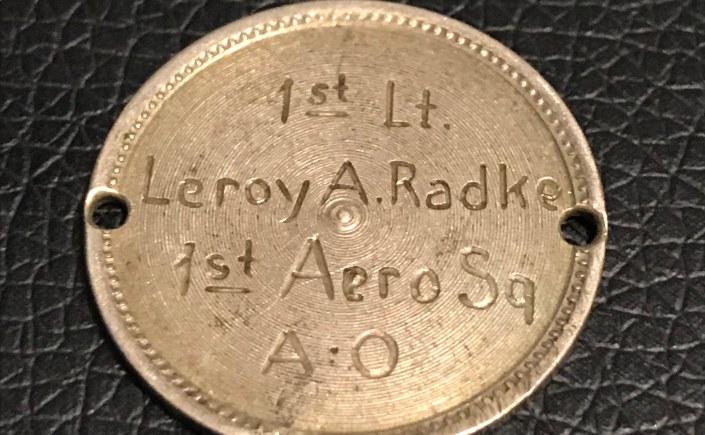
Another artifact ties in possibly with the first story above. Made from a 1915 silver 1 Deutsches Reich Mark, the coin has been milled on the obverse and engraved:
1st Lt.
Leroy A. Radke
1st Aero Sq
A – O
Two holes along the midline were drilled to allow for a piece of twine to wear.


Leroy Arthur Radke (spelled Radtke in some documents) was born on July 28, 1893 in Wisconsin. [3] He was living in Lansing Michigan when he was called to service on May 11, 1917. [4] He went through the Reserve Officer’s Training Camp program at Fort Sheridan, Illinois, graduating and receiving a commission as a 1st Lieutenant, Field Artillery on August 15. [5] He married Helen B. Dolsen while on leave or pass on June 2, 1918. [6] Shortly over a month later, Lt. Radke deployed overseas on July 21, 1918 to France and was assigned to the 1st Aero Squadron as an Aerial Observer. [6] He returned to the United States aboard the USS America and was discharged on October 31, 1919. [7]
Despite his late deployment to France, Lieutenant Radke honorably served as an aviator in literally the premier Aero Squadron in the U.S. military. The 1st Aero Squadron lives on today in the 1st Reconnaissance Squadron, and Lieutenant Radke is a small part of that proud heritage, and part of the legacy of the modern challenge coin.
Sources:
- Lange, Katie. “The Challenge Coin Tradition: Do You Know How It Started?” DOD Live. 13 Oct 2017. Accessed Online 19 Jun 2019. http://www.dodlive.mil/2017/10/13/the-challenge-coin-tradition-do-you-know-how-it-started/
- Ibid.
- Leroy Arthur Radke 1893 – 1973. Findagrave.com. Accessed 18 Jun 2019. https://www.findagrave.com/memorial/85492907/leroy-arthur-radke
- Service summary cards. Photocopied with the coin.
- The Fort Sheridan Officers’ Training Camps. The Fort Sheridan Association. 1920. Pg. 276
- Ancestry.com. Michigan, Marriage Records, 1867-1952 [database on-line]. Provo, UT, USA: Ancestry.com Operations, Inc., 2015.
Original data: Michigan, Marriage Records, 1867–1952. Michigan Department of Community Health, Division for Vital Records and Health Statistics.
- Service summary cards. Photocopied with the coin.
 The Things We Leave Behind
Military challenge coins developed from Masonic challenge coins, some of which show the custom going back well into the 19th century. Despite such evidence the military continuously tries to appropriate the custom as their own. I once sold a rare WW I Masonic Overseas Lodge challenge coin to the Scottish Rite Masonic Museum & Library in Lexington, Mass.
LikeLike